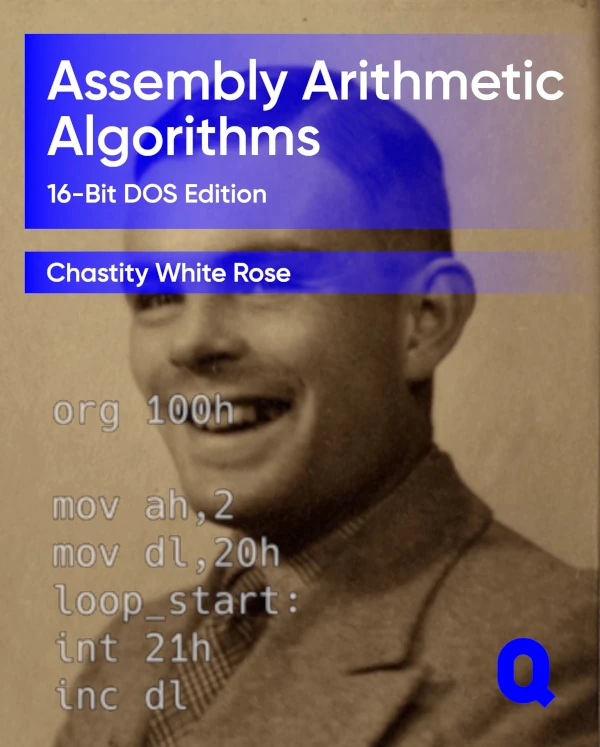
Assembly Arithmetic Algorithms
16-Bit DOS Edition
$39.99
“I think DOS is the best first platform for learning assembly as it sets the stage for using it on other modern operating systems and achieving maximum speed.” - Chastity White Rose
Learn to build small, lightning-fast programs that squeeze every last byte out of your machine. You will gain the confidence to write complete text-based console applications from scratch, controlling the computer directly instead of leaning on layers of abstraction that hide how things really work.
Working through clear, fully explained examples, you will print text and numbers, convert freely between binary, decimal, and hexadecimal, and implement classic integer sequences such as Fibonacci, powers of two, and prime numbers. Assembly Arithmetic Algorithms takes you from your very first program all the way to a reusable function library and a working command-line hex editor, with every instruction broken down so you always know exactly why your code behaves as it does.
You will also learn to translate your assembly skills into C and carry the same techniques onto modern Linux systems in both 32-bit and 64-bit forms. Because each chapter builds on a deliberately small instruction set, you are never buried under hundreds of opcodes, and you steadily develop the ability to write almost any program you can imagine.
Whether you want to become a stronger programmer in any language or simply rediscover the joy of low-level computing, you will finish with practical skills you can apply right away and a far deeper understanding of how computers truly think.
What You Will Learn
- Write complete text-based programs as 16-bit DOS .com files
- Convert numbers between binary, decimal, and hexadecimal
- Build a reusable library of string and integer output functions
- Perform addition and subtraction using only bitwise operations
- Implement integer sequences including Fibonacci, powers of two, and primes
- Translate assembly routines into equivalent C code
Who This Book Is For
Programmers with experience in at least one language who want to understand computers at the lowest level and write their own efficient programs for DOS and Linux.
Unique Selling Points
Teaches a deliberately minimal instruction set, so you can write almost any program without memorizing hundreds of opcodes
Includes complete, downloadable example programs, from a first “Hello World” to a fully working command-line hex editor
Shows assembly and C versions side by side to bridge low-level and high-level programming
Written by Chastity White Rose, author of over twelve books on programming and other subjects
Table of Contents
Chapter 1: The First Program
Chapter 2: The putstring Function
Chapter 3: The intstr and putint functions
Chapter 4: Chastity’s Intel Assembly Reference
Chapter 5: Integer Sequences and Their Application in Learning
Chapter 6: The strint Function
Chapter 7: Translating Assembly to Other Programming Languages
Chapter 8: Going from DOS to Linux or Windows
Chapter 9: Bitwise Operations for Advanced Nerds
Chapter 10: chastehex: Not Just a Program, but a Philosophy
Chapter 11: Bonus Content
Chapter Z: More Documentation
Appendix: System Calls for DOS
About the Author
Chastity White Rose is an author of over twelve books and two WordPress blogs. She writes humorous and educational content about philosophical and religious topics. She also uses her writing and graphic design skills to teach people about the game of chess. She is a creative writing graduate from Full Sail University with self-taught computer programming and graphic design skills. As a transgender Christian woman, she writes books and blog posts to help others like her process the seeming disconnect between religious faith and an LGBTQIA+ identity. She measures the success of her writing by its emotional impact rather than its sales. For this reason, most of her writing is available free of charge.
Related Books